Calcium Buildup, Bead Blasting & Acid Washing Timing
Calcium ring on your tile? Learn when you really need bead blasting, acid washing, and a full drain — and why timing in cooler weather matters for your pool.
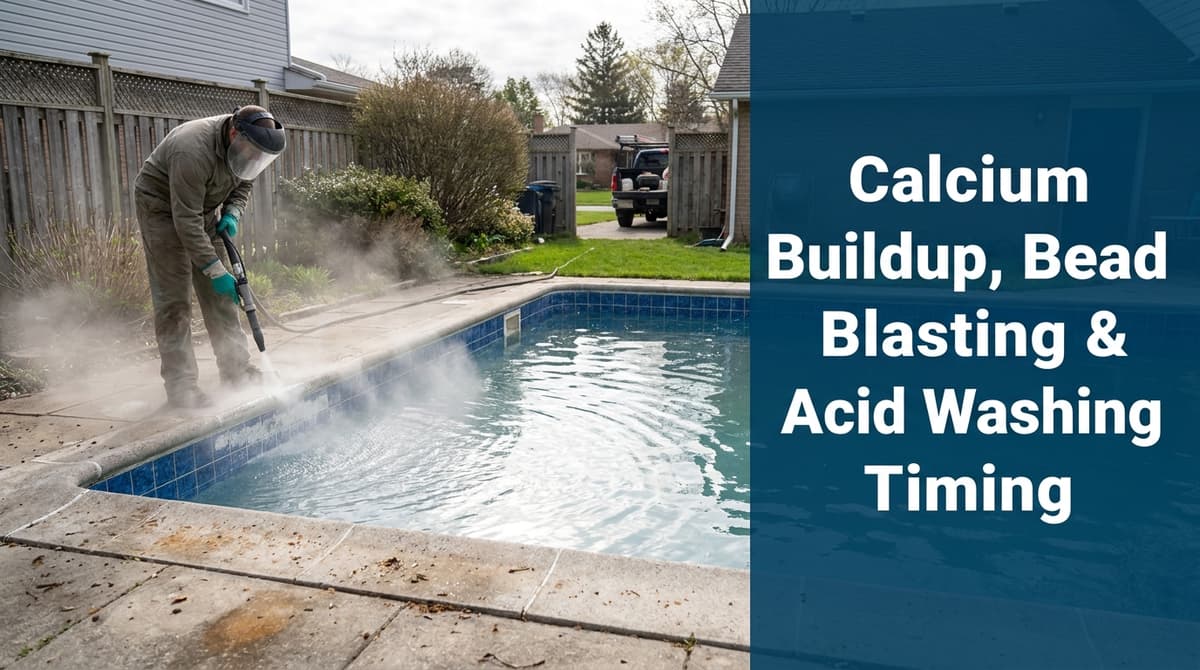
“Do I Need Bead Blasting, Acid Washing, or Both?”
We recently got a call from a customer — let’s call him Mike — who was staring at a white ring of calcium around his pool and wondering if it was time to “do the whole thing.”
Mike had noticeable calcium buildup around the tile line, high hardness and CYA (stabilizer) levels in his water, and a six-year-old Pebble Tec surface. His big question was one we hear all the time:
“If you’re going to drain my pool to bead blast the calcium, shouldn’t we just acid wash it too while it’s empty?”
That call is the perfect example of why timing — and choosing the right service — really matters when it comes to calcium removal, bead blasting, and acid washing.
What That White Ring Around Your Pool Is Really Telling You
In Mike’s case, the first thing he noticed was the hard white line around the tile at the water’s edge. That’s calcium scale, and out here in the desert, it’s almost a fact of life.
Calcium shows up when:
- Your water is hard (high calcium hardness)
- The water level stays in the same place for a long time
- The sun and heat cause heavy evaporation
- The water gets out of balance (high pH, high alkalinity, or both)
The result is that chalky, sometimes rough crust on your tile and spillway. It’s mostly a cosmetic issue at first, but over time it can start to damage tile, grout, stone, and waterline surfaces if you ignore it.
When Your Pool Really Needs Bead Blasting
For that hard calcium line, what Mike actually needed was tile bead blasting, not an automatic acid wash.
Bead blasting is a process where we gently “sandblast” the calcium off using a special media (often glass bead or similar) under controlled pressure. Done correctly, it:
- Removes calcium and scale from tile, stone, and some water features
- Protects the underlying surface when done by a pro
- Allows us to seal the tile afterwards to slow future buildup
On Mike’s call, we told him what we tell everyone: we like to wait until cooler weather (typically fall, when daytime temps are consistently under about 80°F) to schedule draining and bead blasting. That’s because:
- It’s safer for your pool surface to be empty in cooler temperatures
- We can work more comfortably and precisely
- The risk of damage from heat on an empty shell is much lower
We also prefer to drain the whole pool when we bead blast, rather than just lowering the water level. If you only treat part of the tile line and your water is very hard, the scale tends to come back faster and more unevenly.
Acid Washing: Only When You Truly Need It
Mike assumed that if we were draining and bead blasting, we would automatically acid wash his Pebble Tec. That’s a common assumption — and it’s usually wrong.
We explained to him what we explain to every homeowner: acid washing is not routine maintenance. It’s a last resort for specific problems:
- Serious staining (metal stains, deep organic stains that won’t brush off)
- Major discoloration of the surface
- Algae that has deeply penetrated the plaster and won’t respond to normal treatment
On Mike’s call, he told us he didn’t really have staining; he just thought acid washing was part of “the package.” For a six-year-old Pebble Tec that’s never been acid washed and doesn’t have visible staining, our answer is simple: skip the acid wash unless we see a clear reason on-site.
Every acid wash takes a very thin layer off your pool surface. Do it too often, or when it’s not truly needed, and you can actually shorten the life of your finish.
Why Draining Timing Matters (Beyond Just Bead Blasting)
Another issue Mike brought up was that his CYA (stabilizer) and hardness levels were “way above” normal. That’s a big clue that it’s time to drain and refill, even if the pool looked okay from the deck.
We generally recommend draining when:
- It’s been about 5–7 years since the last full drain
- CYA is so high your chlorine is no longer effective
- Calcium hardness is extremely high and hard to manage
That’s why we told Mike that, at around six years on his existing water, yes, it was definitely time to drain. By timing the drain for fall, we could safely:
- Empty the pool for full tile bead blasting
- Evaluate the surface for actual staining before deciding on acid washing
- Refill with fresh, easier-to-balance water
How We Decide What Your Pool Really Needs
When we come out for a job like Mike’s, we don’t just show up and start spraying acid. We walk through a simple decision process:
- Look at the waterline and tile
Is the issue mostly calcium scale? If yes, bead blasting + tile sealing is usually the answer. - Inspect the surface (plaster, Pebble Tec, etc.)
Are there visible stains, mottling, or discoloration that brushing won’t touch? If not, we don’t push an acid wash. - Test the water
High hardness, high CYA, or old water? Then a full drain and refill makes sense, especially when paired with bead blasting. - Factor in age and history
On a relatively young surface (like Mike’s six-year-old Pebble Tec) with no major stains, we aim to preserve the life of that finish by avoiding unnecessary acid washes.
Practical Tips If You’re Seeing Calcium Buildup
If you’re in a similar spot to Mike, here are a few steps you can take before and after we come out:
- Watch your pH and alkalinity – Keeping them in range slows down new scale.
- Don’t attack heavy scale with a screwdriver or metal tool – You’ll chip tile or gouge grout.
- Plan bead blasting and draining for cooler months – It’s gentler on your pool shell and safer overall.
- Ask for tile sealing after bead blasting – It helps delay the return of that white ring.
Not Sure What Your Pool Needs? We’ll Take a Look
Mike’s instinct — “if it’s empty, do everything” — is completely understandable, but not always in your pool’s best interest. The right approach is to:
- Use bead blasting to restore tile and remove visible calcium
- Reserve acid washing for true staining and problem surfaces
- Time draining for cooler weather and when your water chemistry really calls for it
If you’re seeing a stubborn white line, cloudy water, or you know your water is getting old, we’re happy to come out, look everything over, and give you an honest opinion — just like we did for Mike. Sometimes your pool needs all three steps; sometimes it only needs one. The key is knowing when and why to use each service.