How to Deal with Calcium Buildup on Pool Tile
Tired of that white line on your pool tile? Learn the best time of year to clean calcium buildup, how pros remove it, and how to prevent it from coming back.
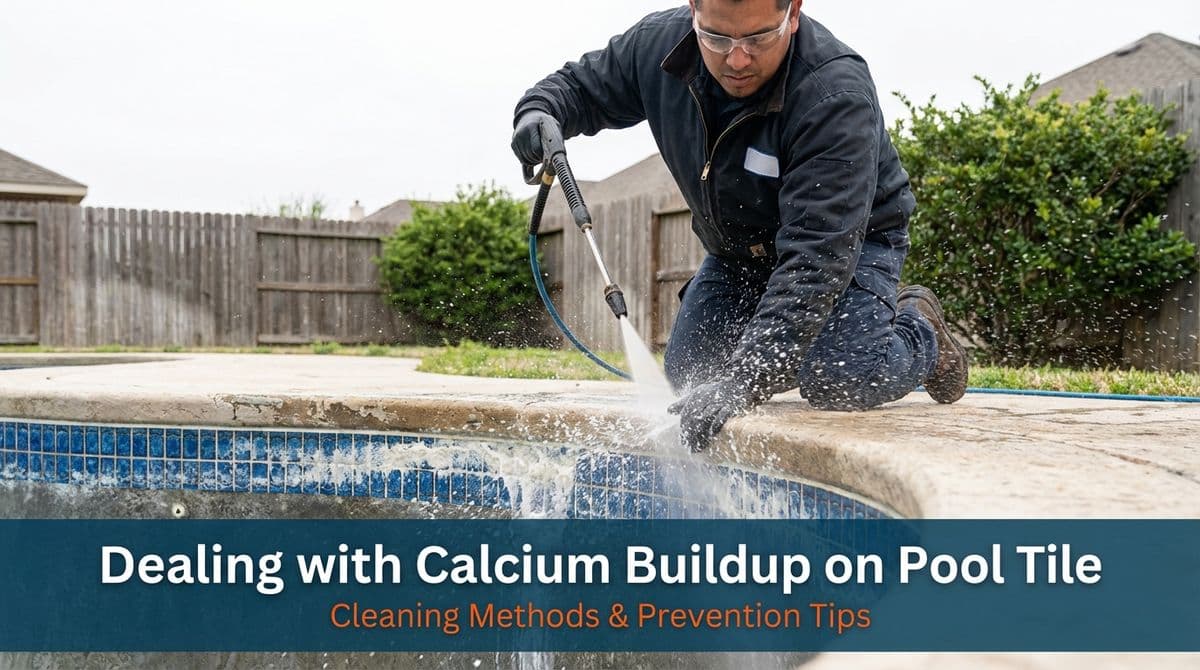
That white crust on your pool tile? You’re not alone.
We recently got a call from a customer — let’s call her Diane — who was looking to schedule her regular filter cleaning. While we were talking, she said, “I think the pool tiles need cleaning too. They look pretty bad again. Do you have to drain the pool to do that? And when’s the best time of year?”
Diane has a Pebble Tec pool, and like many homeowners in our area, she’s dealing with hard water and stubborn calcium buildup along the waterline. We walked her through the options on that call, and we thought it would be helpful to share the same guidance here.
What is that white line on my pool tile?
The white or grayish line that forms at the waterline is usually calcium scale. In areas with hard water, minerals naturally precipitate out of the water and attach to your tile, Pebble Tec, and water features.
Over time, that thin line can turn into a thick, rough crust. If it’s left too long, it becomes harder to remove and can even stain the tile or etch softer surfaces.
We generally see two types of buildup:
- Calcium carbonate – More common, chalky, and a bit easier to remove.
- Calcium silicate – Harder, more tenacious, and often older buildup that’s been there a while.
In Diane’s case, the tiles had been cleaned last year, but the line came back quickly because the water is still just as hard and there wasn’t ongoing treatment to slow the scale down.
Best time of year to clean calcium off pool tile
On Diane’s call, one of her biggest questions was about timing: “Do you drain the pool and then clean the tile? When should I schedule it so it’s not too hot?”
Here’s how we think about timing for professional tile cleaning and bead blasting:
- Cooler months are best. We typically schedule tile cleanings when daytime highs are consistently under about 85°F. Cooler weather is easier on the technician and safer for your pool’s surfaces if the water level has to be lowered.
- We often pause when temps stay in the 80s–90s. Once it’s hot every day, we usually stop scheduling full tile cleanings until it cools back down. Strong sun + low water level can stress plaster and other finishes.
- Pebble Tec gives a bit more leeway. As we told Diane, Pebble Tec can tolerate warm weather a little better than older plaster, so we sometimes have a slightly wider window. Still, earlier in the season is always safer.
If you look at your tile in late winter or early spring and think, “This looks bad again,” that’s exactly when to call us. Waiting too long into the hot season can mean you’re stuck with the buildup until fall.
How we clean calcium off pool tile
Every pool is a little different, but our general approach is:
- Inspect the tile and surface. We look at how thick the scale is, whether it’s tile, Pebble Tec, or another finish, and check for any cracks or loose grout.
- Adjust the water level (if needed). For serious waterline cleaning, we usually lower the water just below the tile so we can work properly.
- Use the appropriate cleaning method. This might include a specialized bead or media blasting system, hand tools, and scale removers designed for pool surfaces.
- Rinse and rebalance the water. Afterward, we clean up the residue, bring the water back to normal level, and make sure the chemistry is in a good range.
We don’t recommend that homeowners take a razor blade or harsh chemicals to their tile. It’s easy to scratch the glaze, damage grout, or unbalance the water. If the buildup is heavy, that’s where we come in.
ScaleTech and other chemical treatments
On the call with Diane, we also talked about an option that doesn’t involve lowering the water: preventive and treatment chemicals. One product we use is a scale-control treatment (we mentioned it to her as “ScaleTech”).
Here’s how treatments like this help:
- They bind minerals in the water so calcium is less likely to deposit on tile and Pebble Tec.
- They can slowly soften lighter scale, making it easier to brush off or prevent it from getting worse.
- They’re usually a cheaper option up front than a full media-blast cleaning.
For homeowners with recurring buildup, we often recommend a full professional cleaning plus an ongoing scale treatment. After a thorough cleaning, we add the product and then help you keep up with regular doses so the line doesn’t come back as fast.
Simple habits to prevent calcium from coming back
Even with treatments, you can do a lot to slow down calcium buildup between professional visits. Here are a few habits we walk customers through:
- Keep your water chemistry balanced. Especially calcium hardness, pH, and total alkalinity. High pH and hardness are a recipe for scale.
- Brush the waterline regularly. Once or twice a week with a nylon brush while the buildup is still soft is much easier than waiting a year.
- Stay current on filter cleanings. Diane was already doing this twice a year, which we love. Clean filters help water circulate properly and make treatments more effective.
- Top off the pool carefully. If your fill water is very hard, topping off often will add minerals. Some homeowners use a pre-filter on their hose to help reduce hardness.
- Address equipment issues. On Diane’s visit, we also looked at her aging vacuum. Poor circulation and dead spots where water doesn’t move well can encourage local scale buildup.
When to call us for professional help
If you run your hand along the tile and feel a rough ridge, or you can see a clearly defined white line even after brushing, it’s probably time to bring us in. We can:
- Assess whether you need a full tile cleaning, a chemical treatment plan, or both.
- Schedule work during the safest time of year for your type of pool.
- Check your filters, cleaner, and circulation while we’re on site, just like we did for Diane.
If you’re looking at your pool tile right now and thinking, “It was just cleaned last year and it already looks bad again,” you’re exactly the kind of homeowner we help every day. Schedule a visit in the cooler months, and we’ll put together a plan to clean things up and keep the calcium from coming back so quickly.