Hayward & Pentair Salt Cells: Choosing the Right Replacement
Confused about Hayward vs. Pentair salt cells? Learn how to match T‑Cell models, AquaRite compatibility, and newer replacements so you buy the right cell the first time.
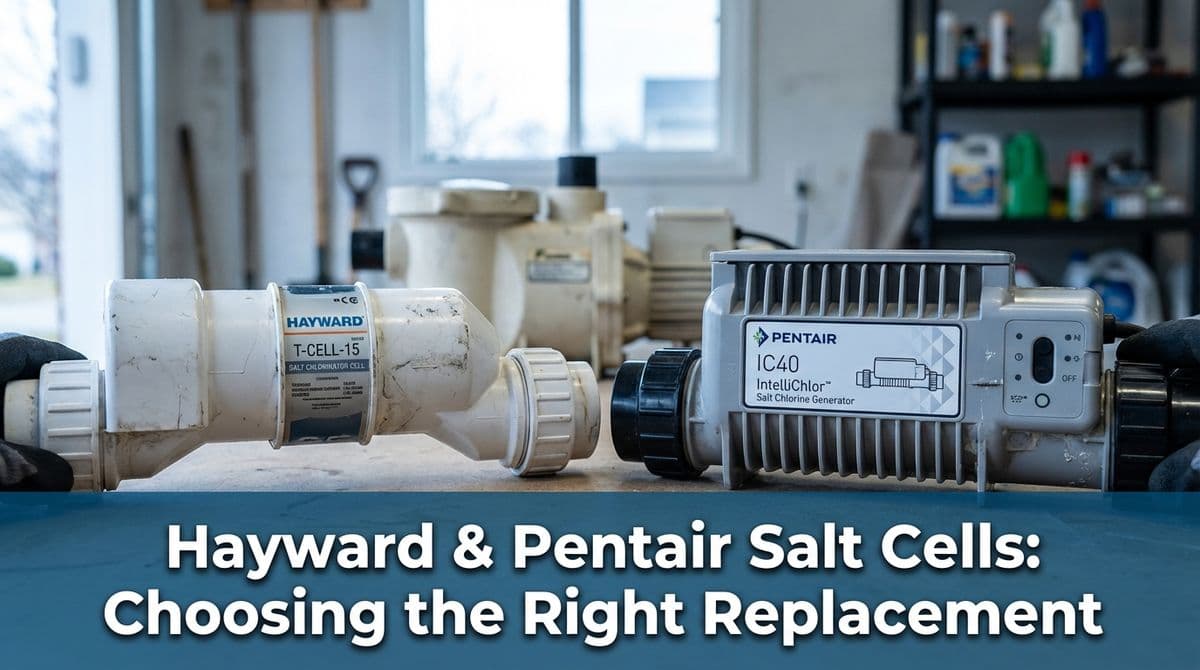
Helping a Customer Decode Hayward vs. Pentair Salt Cells
We recently got a call from a customer — let's call him Mark — who was trying to replace his old Hayward salt cell. He had a Hayward T‑Cell‑9 (a.k.a. TurboCell 9) rated for up to 25,000 gallons, and he wanted to know if we had a replacement in stock and what it would cost.
When we checked our shelves, we had Pentair IntelliChlor/IntelliChlor-style cells in stock, but not his exact Hayward model. Naturally, Mark asked the question we hear all the time: “Can I just use the Pentair cell with my AquaRite panel?”
That simple question opened the door to a bigger conversation about compatibility, model numbers, and newer replacement options. We walked Mark through his choices, and we wanted to share that same guidance here so you can make the right call for your own pool.
Why You Can’t Just Swap a Hayward Cell for a Pentair Cell
The first thing we explained to Mark was that his Hayward AquaRite control panel was designed to talk to specific Hayward-style cells, not Pentair IntelliChlor cells.
Even though they all make chlorine from salt, each brand uses its own communication protocol, connectors, and power requirements. So when we checked the Pentair IntelliChlor option, we had to tell him: it won’t communicate with an AquaRite panel. Plugging it in wouldn’t magically make it work.
Key reasons Hayward and Pentair cells aren’t interchangeable
- Different connectors: The plug style and wiring are not the same.
- Different control logic: The panel expects specific feedback from the cell (voltage, amperage, salt readings).
- Warranty issues: Mixing brands in ways they weren’t designed for can void warranties.
So if you have a Hayward AquaRite system, you should be looking at Hayward-compatible T‑Cell models or their newer equivalents, not Pentair IntelliChlor cells.
Understanding Hayward T‑Cell Models (T‑3, T‑9, T‑15, etc.)
Mark’s cell was labeled as a T‑Cell‑9 TurboCell. Over the years, Hayward has sold these under slightly different names (including Goldline), which adds to the confusion. The good news is that the basic sizing concept is simple.
Common Hayward TurboCell sizes
- T‑Cell‑3 – For pools up to roughly 15,000 gallons
- T‑Cell‑9 – For pools up to roughly 25,000 gallons (this is what Mark had)
- T‑Cell‑15 – For pools up to roughly 40,000 gallons
As Hayward updates their product line, older models are sometimes discontinued or renamed. In Mark’s case, we had to dig a bit and found that Hayward has newer replacement part numbers (like the GLX‑CELL‑9 family and the S3 series) that serve as direct replacements for the classic T‑Cell‑9.
Newer replacements and AquaRite compatibility
On the call, we located a newer style replacement (listed as an S340‑style cell) that would still work with his AquaRite panel. That’s the kind of thing that trips a lot of homeowners up: the sticker might not say “T‑Cell‑9,” but it’s engineered to be a drop‑in compatible part.
Whenever we’re sourcing a cell, we always confirm:
- Original cell size (T‑3, T‑9, T‑15)
- Pool volume in gallons
- Exact model of the control panel (e.g., AquaRite vs. AquaTrol)
Those three pieces of information let us match you to the correct modern replacement.
Hayward vs. Pentair: Lifespan, Warranty, and Cost
Mark’s reaction to the price we quoted — a little over $1,300 for the genuine replacement — was completely understandable. Salt cells aren’t cheap, so it helps to know what you’re really getting.
Typical lifespan
- Hayward cells: Commonly last around 3–5 years, depending on run time, water balance, and maintenance.
- Pentair IntelliChlor cells: Similar ballpark, often 3–7 years with proper care.
Both brands are comparable when the water is kept balanced and the cell is cleaned properly (and not over‑cleaned with too‑strong acid).
Warranty differences
- Hayward: Many genuine cells carry a 3‑year limited warranty when installed as part of a complete system.
- Pentair: IntelliChlor warranties typically range from 2–3 years, depending on whether they’re installed by a pro and part of a full Pentair setup.
Exact coverage varies by model and how it’s purchased, but in general, buying an OEM cell for the matching control system gives you the best warranty support.
Before You Buy: Is Your Salt Cell Really Dead?
One of the most helpful things we can do for customers is make sure they actually need a new cell. Here’s a quick checklist we walk through before recommending replacement.
Quick homeowner troubleshooting checklist
- Check your salt level. Use a separate test (strip or drop test) and confirm it matches the panel reading within about 200–300 ppm.
- Inspect the cell. Turn off power, remove the cell, and look for heavy white scale or broken fins/plates.
- Clean if needed. If scaled, soak in a mild 4:1 water-to-muriatic-acid mix for a few minutes only, then rinse and reinstall.
- Verify flow. Make sure your pump is running with good flow and the filter isn’t clogged; many “cell” errors are really low‑flow issues.
- Check runtime and settings. In hot weather or heavy use, you may simply need to increase pump run time or output percentage.
If, after all that, your AquaRite still shows “Inspect Cell”, low current, or persistently low salt readings — especially on an older cell (4–5+ years) — it’s probably time for a replacement.
Common Compatibility Mistakes We Help Homeowners Avoid
Mark’s situation is one we see in different forms all the time. Here are a few common mistakes we help people steer clear of.
1. Mixing brands without changing the whole system
Just like in Mark’s case, homeowners sometimes want to plug a Pentair cell into a Hayward panel (or vice versa) to save money. We always explain that unless you’re ready to replace the entire control system, you need to stay with the brand your panel is built for.
2. Downsizing the cell to save cash
We sometimes get calls from customers with a 20,000–25,000 gallon pool who want to drop from a T‑Cell‑9 to a T‑Cell‑3 because it’s cheaper. On paper it might “work,” but in real life the smaller cell will have to run longer and harder, shortening its life and struggling in peak summer. We almost always recommend sizing the cell to your actual pool volume — or even one size up.
3. Ignoring the control panel version
Certain older AquaRite boards may need a software update or configuration setting changed when you switch between T‑Cell sizes or to newer replacement models. We double‑check your panel’s label and software revision so you don’t end up with constant error lights after installing a brand‑new cell.
How We Help You Choose the Right Replacement Cell
When Mark decided to hold off, we completely understood — a salt cell is an investment. But now he knows exactly what he needs and what it costs, and he can call us back anytime when he’s ready.
If you’re in the same boat, here’s what we’ll ask you when you call or stop by:
- Brand and model of your control panel (photo of the label helps).
- Exact model name/number on your current cell (T‑Cell‑9, etc.).
- Pool size in gallons and whether it’s plaster, pebble, or vinyl.
- Any error messages or warning lights your system is showing.
From there, we can tell you whether a Hayward replacement T‑Cell (or its newer equivalent) is your best bet, or whether it might make sense to consider a full system upgrade to something like Pentair IntelliChlor if your equipment is aging out.
If you’re unsure what’s installed on your pad, snap a few photos of your equipment labels and give us a call. We’ll help you sort out exactly which Hayward or Pentair salt cell will keep your pool clear, comfortable, and easy to maintain — without wasting money on parts that won’t work with your system.