Hayward Valve Actuators 101: Choosing and Calibrating
Learn how Hayward-style valve actuators work, how to choose a compatible replacement, and why calibration is critical for proper pool and spa operation.
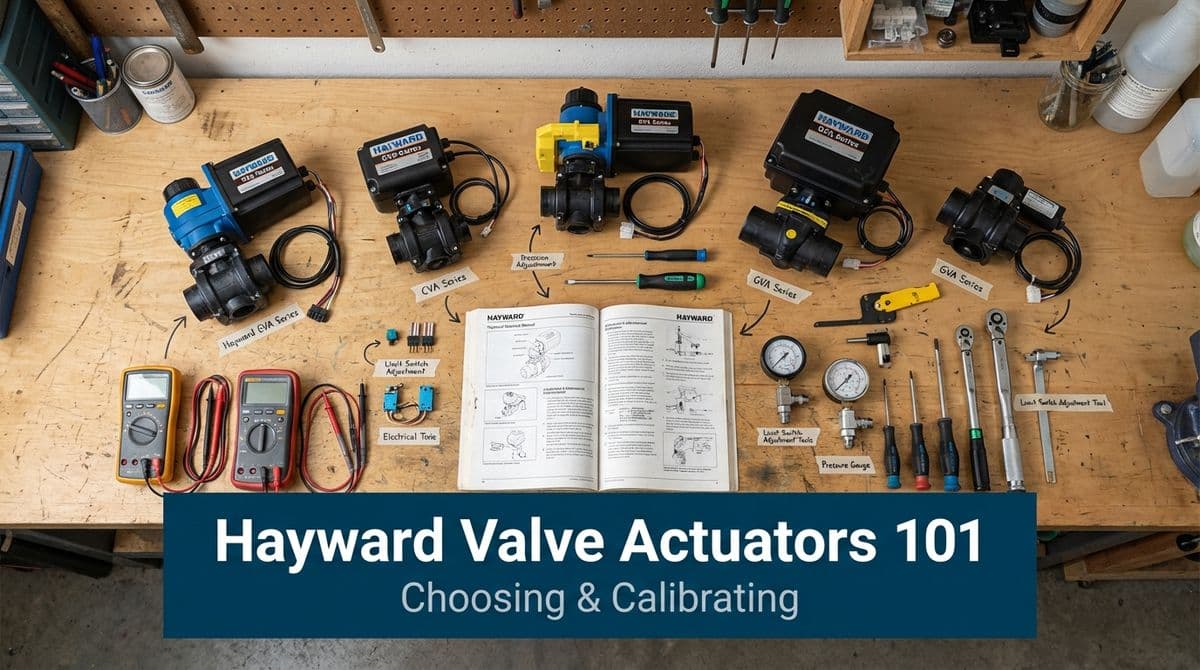
Why a Simple Call About a Hayward Actuator Turned Into a Mini Pool Lesson
We recently got a call from a customer — let’s call him Tyler — who needed a Hayward valve actuator fast. His pool wasn’t switching properly between pool and spa, and he was pretty sure the little motorized unit on top of his valve had given up.
Tyler told us he had a 24-volt Hayward Goldline-style actuator and wanted to know if we had that exact brand in stock. That kicked off a great conversation about how these actuators work, whether an alternate brand will do the job, and why calibration matters more than most people realize.
Since we have this same discussion with a lot of pool owners, we figured it’d be helpful to walk through the basics here: what a valve actuator does, how to choose the right replacement, and how to make sure it’s calibrated so your system runs the way it should.
What a Pool Valve Actuator Actually Does
When Tyler said, “I just need the unit that turns the valve,” he described an actuator perfectly. The actuator is the motorized top piece that mounts onto a diverter valve (usually a 2-way or 3-way valve) and rotates the internal diverter for you.
If you have a pool with a spa, water features, or in-floor cleaning, chances are you’ve got at least a couple of actuators sitting on top of valves by your equipment pad.
In plain terms, here’s what an actuator does:
- Receives a 24V signal from your automation system or timeclock.
- Rotates the valve between two positions (usually 180° apart).
- Stops at internal limit switches so it doesn’t spin endlessly.
- Lets you control water flow — pool vs. spa, suction vs. return, water features, etc. — at the touch of a button.
When an actuator fails, you may see symptoms like your spa draining down, no water going to the spa jets, or the system refusing to switch from pool mode to spa mode. That’s often the point when we get a call like Tyler’s.
Hayward vs. Other Brands: Do You Need the Exact Match?
Tyler asked us specifically for a Hayward actuator. On that day, we didn’t have a Hayward in stock, but we did have a 24V Intermatic actuator that’s compatible with the same style of valve. It was also about $100 cheaper.
This raises a common question: Do you really need the Hayward-branded actuator if you already have Hayward equipment?
What actually needs to match?
- Voltage: The vast majority of pool actuators are 24V AC. This must match your automation system.
- Mounting pattern: Most modern actuators from Hayward, Jandy, Pentair, and Intermatic share a similar mounting footprint for standard 2- and 3-way valves.
- Rotation range: Typical pool actuators rotate 180°, but some applications use 90°. Make sure the actuator can be set for what your system needs.
As long as those three items line up, a quality non-OEM actuator will usually work just fine. That’s why we were able to recommend the Intermatic option to Tyler as a same-day solution.
Brand vs. warranty and support
Tyler mentioned he was seeing Hayward actuators on Amazon for around $200, cheaper than what we could order from our supplier. We’re the first to admit that sometimes online prices beat local store pricing, but we always remind homeowners of one thing:
- Check the warranty. Not every online listing includes the full manufacturer warranty.
- Consider support. If something goes wrong out of the box, it’s usually easier to work with a local store or installer than with a random online seller.
If the online option is truly the same part with a legitimate manufacturer warranty, we’ll be honest and say it can be a good deal. But if you want in-person guidance, local warranty help, or professional installation, that’s where a local shop like ours earns its keep.
Why Calibration Matters (And No, They Don’t Come Pre‑Set)
One of Tyler’s big questions was whether the actuator came pre-calibrated at 180°. He’d heard that Hayward actuators arrive ready to go. Our techs confirmed what we see in the field every week: none of them come perfectly calibrated for your specific plumbing setup.
Out of the box, actuators are generally set up for a standard 180° sweep, but your pool may need:
- A full 180° rotation between pool and spa.
- A partial rotation for a water feature or cleaner line.
- A reversed direction if the actuator is mounted the other way around.
That’s where calibration comes in. Inside the actuator, there are usually adjustable cams or limit switches that tell the motor when to stop in each direction. During installation, you (or your technician) align those stops so the valve ports line up correctly with your plumbing.
What happens if calibration is off?
- Your spa may drain down because the suction or return isn’t fully shut off.
- You may get weak spa jets because some water is still going to the pool.
- In-floor cleaners or water features may not activate properly.
- The actuator may hit a hard stop and strain the motor.
Spending a few extra minutes to set those limits properly can save you a lot of frustration (and sometimes a service call) later on.
Simple DIY Checklist for Replacing a Valve Actuator
If you’re reasonably handy and comfortable working around your equipment pad, many homeowners can swap out an actuator themselves. Here’s a basic checklist we often walk customers through:
Before you start
- Turn off power to your automation system or pump at the breaker.
- Take a photo of the existing actuator position and wiring for reference.
- Confirm you have the correct 24V actuator and mounting screws.
Installation steps (high level)
- Remove the four screws holding the old actuator to the valve.
- Carefully lift the actuator off, noting the valve handle position underneath.
- Transfer or reconnect the wiring exactly as it was (this is where that photo helps).
- Set the new actuator on the valve so its indicator arrow matches the valve handle position.
- Secure it with the screws, then turn the power back on.
- Use the manual toggle switch on the actuator or automation control to cycle it and check travel.
If the valve doesn’t stop where it should, that’s your cue to adjust the internal cams or stops per the manufacturer’s instructions. If that part feels overwhelming, that’s when we typically recommend calling a pro.
Quick FAQ: Common Actuator Questions We Hear
How do I know if my actuator is bad and not the valve?
If the handle on the valve is stiff or impossible to turn by hand, the valve itself may be the culprit. If the valve turns smoothly by hand but the actuator clicks, hums, or doesn’t move, the actuator is usually the issue.
Can I mix brands — Hayward valve with Intermatic actuator?
In many cases, yes. As long as the bolt pattern, shaft style, and 24V supply all match, mixing brands is common. We do it in the field when the original brand isn’t available and a quality alternative is in stock.
Do I need to replace the valve and actuator together?
Not necessarily. If the valve body and diverter are in good shape and only the motorized top has failed, you can usually replace just the actuator. We only recommend changing the whole valve when the internals are cracked, leaking, or severely worn.
When to Call in a Professional
In Tyler’s case, he really wanted something he could pick up and install the same day, and we walked him through the pros and cons of the options. Whether you buy from us, online, or somewhere else, the keys are the same: match the specs, verify the warranty, and make sure it’s calibrated correctly.
If you’re unsure about wiring, cam adjustments, or your system has multiple valves and actuators working together, it can be worth having a technician come out. We can diagnose whether the issue is the actuator, the valve, or the automation system, install the right part, and dial in the calibration so your pool and spa do exactly what you expect when you hit that button.
And if you’re standing in front of your equipment pad right now wondering which actuator you have and what to order, feel free to give us a call — we’re happy to talk through it, just like we did with Tyler.