How to Refill & Re‑Balance a 10,000‑Gallon Salt Pool
Drained a 10,000-gallon saltwater pool? Learn how many bags of salt to add, how to re-balance chemistry, and when to call a pro after a full refill.
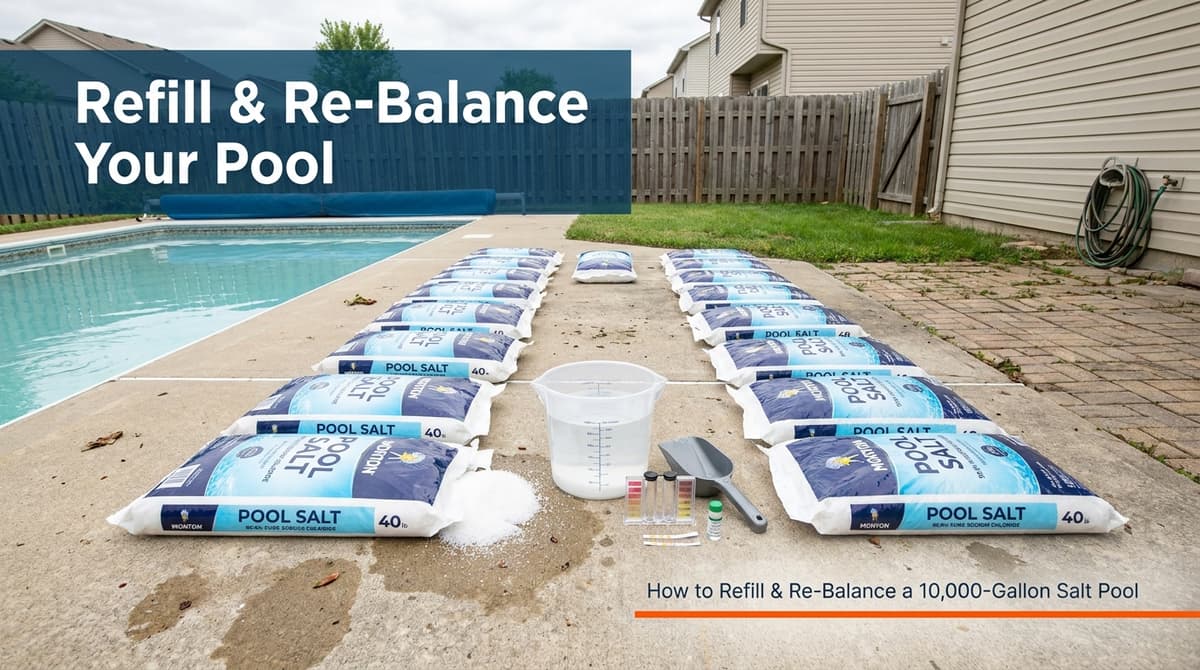
Refilling and Re‑Balancing a 10,000‑Gallon Saltwater Pool
We recently got a call from a customer — let’s call her Linda — who was planning to drain her 10,000-gallon saltwater pool. After years of use, she wanted to start fresh and was trying to figure out two big questions:
- How much salt does a 10,000-gallon salt pool need after a full refill?
- What else should she do to get the water properly balanced again?
Linda also asked if she could acid wash the pool herself after draining, or if that was something we should handle. We walked her through the numbers on salt, talked about the ideal salinity level for her salt cell, and explained what the full refill-and-rebalance process should look like.
In this post, we’ll share that same guidance with you, step by step, so you can confidently refill and re-balance a 10,000-gallon saltwater pool after draining.
Step 1: Know Your Target Salinity (Around 3,200 ppm)
The first thing we asked Linda was what kind of salt system she had. Different salt cells have slightly different recommended salinity ranges, but most modern systems, including the one she uses, like to sit around 3,200 parts per million (ppm).
That number is important because it’s what we use to calculate how much salt to add. Your owner’s manual or the label on your salt cell will usually list a recommended range, such as 2,700–3,500 ppm. We aim near the middle so the system can work efficiently without stressing the cell.
If you’re not sure about your system’s target range, look it up before you start. Adding too much salt is a lot harder to fix than adding a little less and topping off.
Step 2: How Much Salt for a 10,000‑Gallon Salt Pool?
When Linda asked, “How many bags of salt will I need?”, we walked through the math and then gave her a simple, practical starting point.
For a 10,000-gallon pool being refilled with fresh water (which we assume has almost no salt), and targeting around 3,200 ppm, we typically recommend:
- Start with about 8 standard 40-lb bags of pool salt.
That’s the same recommendation we gave Linda: start with eight bags, let everything dissolve, then test your salt level and adjust if needed. Why not just calculate it exactly and dump it all in? Because:
- Some water sources already have a small amount of salt.
- Your true pool volume may be a bit more or less than 10,000 gallons.
- It’s much easier to add a little more salt than to correct an oversalted pool.
Once the first 8 bags are in and dissolved, test the salinity with a good digital tester or a salt test strip. If you’re a few hundred ppm low, you can safely add another bag or two, retest, and dial it in.
Step 3: The Right Way to Add Salt After Refilling
When Linda refills her pool, we’ve suggested she follow a simple process to give her salt system the best start:
- Refill completely with fresh water before adding any chemicals.
- Start the circulation system and let it run continuously while adding salt.
- Broadcast the salt evenly around the deep end of the pool, walking around the perimeter instead of dumping all in one spot.
- Brush the pool surfaces to help dissolve salt piles on the bottom so they don’t sit and potentially stain or etch the surface.
- Run the pump for at least 24 hours to fully circulate and dissolve the salt before you test salinity or turn on the salt chlorine generator.
We told Linda the same thing we tell all our salt pool customers: don’t rely on the salt cell’s reading immediately after adding salt. Let the system circulate, then test independently so you know exactly where your salinity stands.
Step 4: Re‑Balance Chemicals After a Fresh Fill
Salt is only part of the story. After a drain and refill, your water chemistry is essentially starting from zero. Here’s the basic re-balance sequence we recommend, and that we would follow if we handle the refill for you:
- Adjust pH and Total Alkalinity (TA)
Get TA in range (usually 80–120 ppm), then dial in pH (7.2–7.6). These two levels affect almost everything else, from comfort to surface protection. - Check and adjust Calcium Hardness
This is especially important for plaster or pebble pools. Too low and the water can etch your surface; too high and you’ll deal with scale. - Add stabilizer (cyanuric acid)
Salt systems still produce chlorine, and that chlorine needs protection from the sun. For most salt pools, 60–80 ppm CYA is a common target, but always follow your system’s recommendations. - Turn on and dial in the salt system
Once salinity is in range and other chemistry is balanced, turn on the salt cell and set its output. After a day or two, test chlorine levels and tweak the percentage as needed.
We walked Linda through this sequence because going out of order can lead to a lot of backtracking and chemical waste.
What About Acid Washing After a Drain?
Linda also asked if she could acid wash the pool herself. While some experienced homeowners do tackle this, we’re very cautious about recommending it as a DIY project for a few reasons:
- Muriatic acid is hazardous and requires strict safety gear and handling.
- Over-etching can damage plaster or pebble finishes, shortening the life of your surface.
- Proper neutralization and disposal are crucial to protect equipment and the environment.
When Linda asked, we offered to send someone out to quote a professional acid wash. If we handle it, we also manage the refill, salt addition, and full re-balance so everything is done in one coordinated process.
When to Call in a Pro
If you’re comfortable with basic pool chemistry, you can absolutely handle the refill, salt addition, and balancing yourself using the guidelines above. That said, we usually suggest calling us if:
- You’re planning a full drain and acid wash.
- You’ve struggled with getting your salt system dialed in before.
- Your pool surface is older or showing signs of damage or scaling.
Whether you decide to DIY like Linda was considering or have us take care of the heavy lifting, starting with the right amount of salt — around eight 40-lb bags for a fresh 10,000-gallon fill — and following a careful re-balance process will help your salt system run smoothly and keep your water sparkling.