How to Choose the Right Size Gas Pool Heater
Thinking about a gas pool heater? Learn how pros size heaters by BTUs, pool volume, and gas line limits before installation so you get reliable, efficient heating.
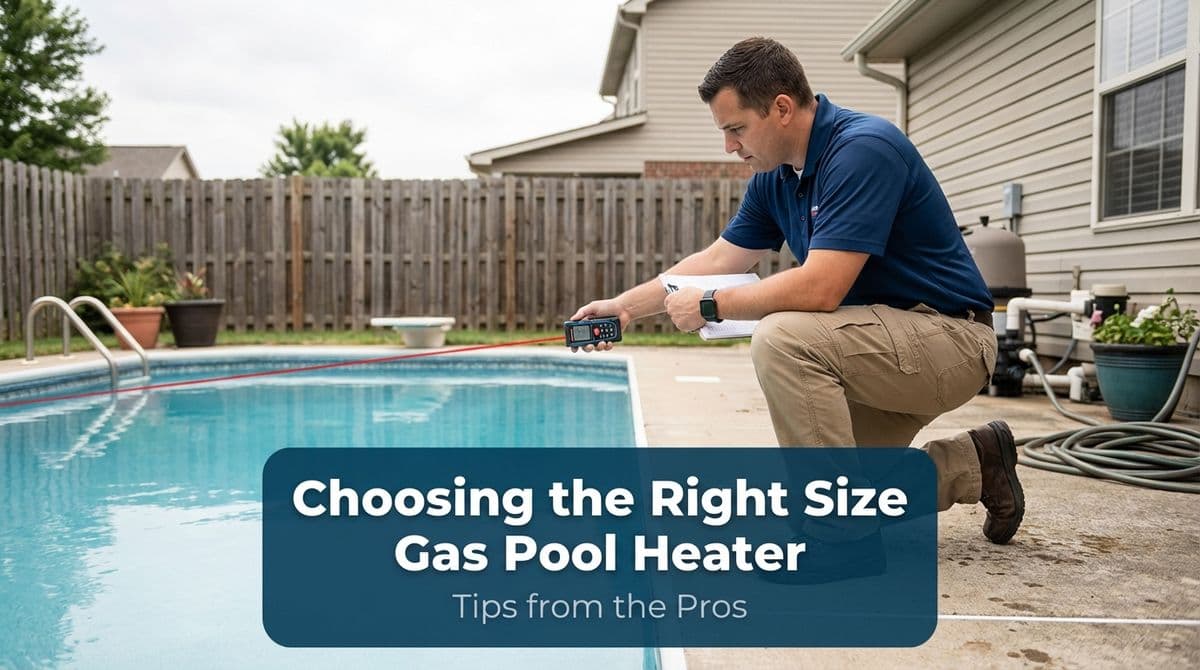
Helping a Customer Make Sense of Pool Heater Sizes
We recently got a call from a customer — let's call him Mark — who had a great question about gas pool heaters. A few years ago, he’d had a pool installed, and now he was ready to add a heater. The builder had recommended a Hayward gas heater, specifically a 275,000 BTU model, but Mark wasn’t sure if:
- That size was really right for his pool, and
- The quote he’d been given was reasonable
He told us, “It’s just a small, tight pool. I can’t remember the gallons, but I’m sure they picked 275,000 BTUs because they know the pool.” Mark’s question to us was what a lot of homeowners wonder: How do you actually choose the right size gas pool heater?
We walked Mark through exactly what our technicians look at before we quote or install a heater. In this post, we’ll share that same thought process with you.
What BTUs Really Mean for Your Pool
When Mark read “275,000 BTU” on his quote, it sounded big and technical, but not very clear. We explained that BTU (British Thermal Unit) is simply a measure of how much heat the heater can put into your pool water in an hour.
Here’s the simple way to think about it when we’re recommending heaters: the higher the BTUs, the faster your pool will heat up. It’s a lot like comparing a small stovetop burner to a big one. Both can eventually boil a pot of water, but the bigger burner gets you there faster.
However, bigger isn’t always better. Our job is to match the heater’s BTU output to:
- Your pool’s water volume (gallons)
- Your desired temperature rise
- How fast you want to get there
- Your gas line capacity and equipment pad setup
Step 1: Understanding Your Pool Volume
Mark couldn’t remember how many gallons his pool held — and honestly, that’s pretty common. A lot of homeowners just know they have a “small” or “medium” pool. When we visit a property, we either get the gallon figure from the build plans or we estimate it based on the dimensions and depth.
As a rough guide, here’s how we often categorize pools:
- Small pools/spools: 5,000–10,000 gallons
- Medium pools: 10,000–20,000 gallons
- Large pools: 20,000+ gallons
The more water you have, the more BTUs you need to heat it efficiently. For a “small, tight pool” like Mark’s, 275,000 BTUs is usually more than enough and often right in the sweet spot for quick heat-up times.
Step 2: How Fast Do You Want to Heat the Pool?
After we talk about pool size, we always ask homeowners how they plan to use their heater. With Mark, we asked if he wanted to:
- Keep the pool at a steady temperature for much of the season, or
- Turn the heater on occasionally and warm it up quickly for weekend use
That answer matters. If you want to go from chilly to comfortable in just a few hours, a higher-BTU heater like a 250,000–400,000 BTU unit can make a big difference. If you’re okay with a slower, more gradual warm-up, you can sometimes size slightly smaller.
In our climate, most customers want the flexibility to heat on demand, so we tend to size on the stronger side rather than the bare minimum. For Mark’s small pool, 275,000 BTUs would give him nice, responsive heating without being excessive.
Step 3: What Our Technicians Look At On-Site
On the phone, Mark asked us a key question: “What’s the technician gonna look at?” That’s exactly why we prefer to send a tech before giving a final quote. There are details we just can’t see over the phone.
When we come out to quote a gas pool heater, here’s what we typically examine:
1. Gas Line Availability and Sizing
Mark’s pool was a fresh install with no gas line run yet. That changes the scope of the job. Our technician will:
- Check where your gas meter is located
- Look at how far we need to run the gas line to the equipment pad
- Confirm that your existing gas service can support the new heater’s BTU load
A 275,000 BTU heater needs a properly sized gas line. If the line is too small or too long for its size, the heater won’t fire correctly and you’ll end up with performance issues. We’d rather size the gas line right the first time than “make do” with what’s there.
2. Equipment Pad Space and Layout
We also look closely at the equipment pad. Even if you already have a Hayward system, we need to confirm:
- There’s enough physical space for the heater
- We can maintain safe clearance around the unit
- The exhaust won’t be blocked by walls, overhangs, or landscaping
Proper placement affects both safety and performance. We’ve seen heaters crammed into tight corners where they can’t breathe properly — and that shortens their lifespan. When we’re on site, we lay out where everything will go so it looks clean and works correctly.
3. Integration With Your Existing System
Like Mark, many homeowners already have a Hayward automation system and app. He specifically wanted to stick with Hayward so everything would talk together. We completely understand that, and we take that into account when we recommend specific models.
On site, we verify that:
- Your current automation panel can control the heater
- Wiring and low-voltage connections are straightforward
- The heater model we recommend matches your system’s capabilities
That way, when we’re done, you can control your heater from the same app you already use for your pump, lights, and features.
Why We Don’t Give “One-Size-Fits-All” Quotes Over the Phone
During our call, we explained to Mark that we could ballpark some options, but to give him an accurate quote, we needed a technician to look at his setup. For a big item like a gas pool heater, there are just too many variables:
- Gas line length and routing
- Trenching or hardscape we may have to work around
- Breaker space and electrical needs for ignition and controls
- Local code requirements and clearances
Our goal is to give you a number that actually holds up — not a low phone estimate that jumps once we see the job in person. When we recommend a 275,000 BTU heater (or any size), we’re factoring in everything we saw on site, not just guessing off pool size alone.
Thinking About a Gas Pool Heater for Your Pool?
If you’re like Mark and you’re wondering whether a 275,000 BTU heater is right for your pool, the best next step is a professional evaluation. We’ll look at your pool volume, your usage habits, your gas service, and your existing equipment, then walk you through a couple of heater options that make sense.
When we leave, you’ll know:
- What size heater we recommend and why
- What it will take to run a gas line (if you don’t have one yet)
- How your new heater will integrate with your controls or app
- The total installed price — no surprises
Whether you’re just starting to research or you already have a quote you want to compare, we’re happy to take a look and help you choose the right size gas pool heater for your backyard.